

Project
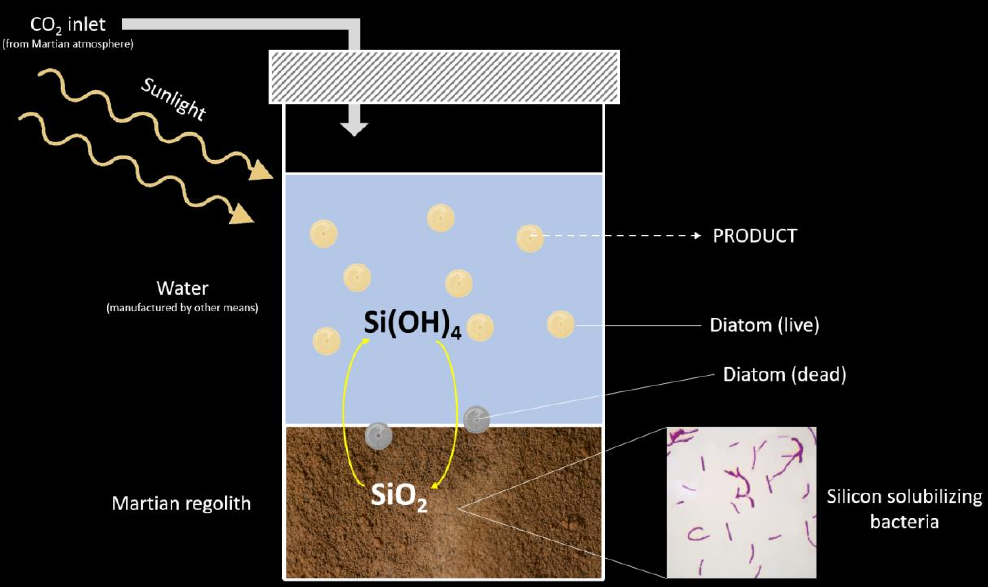
A major component of Martian soil is silica (SiO2). Various bacterial species, like Pseudomonas sp. and Bacillus sp., have been shown to possess the ability to solubilize silica into aqueous silicic acid (Si(OH)4). Unicellular aquatic algae called diatoms can take this up and metabolize it back into silica, in order to produce a protective outer covering that is necessary for their survival. Diatoms are photosynthetic and can produce their own food, as long as carbon dioxide and sunlight are present. When these diatoms die, they also shed their silica covering. This silica, along with the dead diatoms’ cells, can act as a substrate for further bacterial growth. Diatoms can also be genetically engineered to produce compounds of interest. Thus, a system of silica-solubilizing bacteria and diatoms can form a closed-loop system for nutrient and silica recycling, from which a chemical of human interest can be obtained.
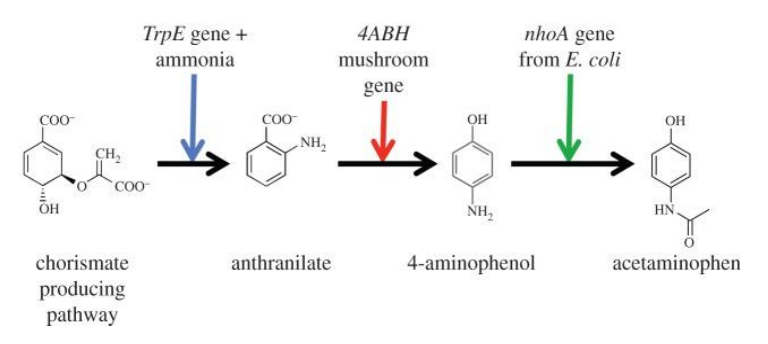
An example of a product that can be obtained from the diatoms is acetaminophen (paracetamol). By utilizing the naturally-occurring chorismate in diatoms and introducing the necessary genes, as suggested by Menezes et al., we can synthesise acetaminophen. This has pharmaceutical use for humans who may settle on Mars.
The experimental details of the project are yet to be worked out in detail. Potential silicon-solubilizing bacteria we could use are Bacillus subtilis, which can be obtained from the UG lab, or Pseudomonas putida, which Prof. Satyanarayana Gummadi and Prof. Krithika Ravi’s labs have experience working with. Diatoms can easily be obtained from the beach or from conventional sources. The Martian regolith can be obtained for a relatively low cost from the Exolith Lab at the University of Central Florida. The team would have to design a minimal nutrient powder to be mixed with the regolith to act as a “seed” for bacterial growth. There are a good number of research papers that discuss the genetic engineering of diatoms. We could seek the help of Prof. Smita Srivastava to do this, as she has experience with plant synthetic biology.